

NetOwl Extractor
Entity Extraction
Entity extraction (aka named entity recognition or NER) finds entities such as person, place, organization, and product names in text using AI-based natural language processing (NLP) and machine learning technologies. NetOwl offers highly accurate, fast, and scalable entity extraction in multiple languages.

Advanced Entity Extraction Powered by NLP
NetOwl entity extraction leverages a wide range of advanced NLP technologies to deliver best-in-class accuracy, speed, and scalability, while offering an extensive set of cutting-edge capabilities, such as relationship extraction, event extraction, and geotagging.
NetOwl is engineered from the ground up for high-volume, real-time text processing, providing extremely fast text analysis and horizontal scalability to handle any surges in volume.
By training on a broad spectrum of text types, NetOwl achieves high accuracy not only on well-edited content such as news articles and Wikipedia – where most entity extraction tools focus – but also on ‘noisy’ text that may lack capitalization, punctuation, or standard grammar.
NetOwl includes a rich, fine‑grained entity ontology out of the box, with over 100 entity types that go far beyond a basic one. It’s designed to support a diverse set of domains and use cases effectively.
Key Product Features

Accurate
Provides state-of-the-art entity extraction accuracy even on noisy text.

Extensive Ontology Coverage
Extracts to a semantic ontology consisting of over 100 types of entities.

Customizable
Creator Edition (CE) enables the customization of existing entity types or addition of new entity types.

Multilingual
Supports multiple languages including English, Arabic, Chinese (traditional and simplified), French, German, Persian (Farsi and Dari), Russian, and Spanish.

Fast & Scalable
Extremely fast for real-time analysis. Highly scalable entity extraction software with Docker and Kubernetes support.

Easy Integration
Easy-to-integrate entity extraction product with a REST API. Pre-integrated with popular search and analytics tools like Elasticsearch and Esri ArcGIS.

What Entity Extraction Challenges does NetOwl Handle?
NetOwl addresses a wide variety of entity extraction challenges including:
- Entity Type Ambiguity: The same name may refer to entities of different types depending on context:
- Washington State (state) vs. Washington DC (city) vs. George Washington (person)
- Part of Speech Ambiguity: The same word may have multiple grammatical functions depending on context:
- May Stevens (first name) vs. Tom May (last name) vs. May (month) vs. may happen (auxiliary verb)
- Semantic Ambiguity: The same word may have different meanings that result in an ambiguous context for entity extraction:
- crane operator Chris Johnson (person) vs. tour operator XYZ Adventure (organization) vs. logical operator XOR (a function in programming)
- Natural Language Creativity: New names are constantly created for companies, products, and even personal and place names.
- Noisy Text: Unlike well-edited texts such as newspaper articles, real-world text is often messy. Social media posts, emails, chats, and certain specialized messages often lack proper capitalization and punctuation, contain typos, misspellings, and domain-specific abbreviations, and may be ungrammatical. In addition, texts from sources like OCR and ASR are prone to errors.
Extensive Ontology for Entity Extraction
With over 100 types of entities, NetOwl entity extraction offers a broad semantic ontology that goes beyond that of standard named entity extraction software. It includes people, various types of organizations (e.g., companies, governments), several types of places (e.g., countries, cities), addresses, artifacts, phone numbers, titles, etc. This expansive named entity recognition forms the foundation for more advanced relationship extraction and event extraction.
Domains include Business, Finance, Politics, Homeland Security, Law Enforcement, Military, National Security, and Social Media.
Multilingual Entity Extraction
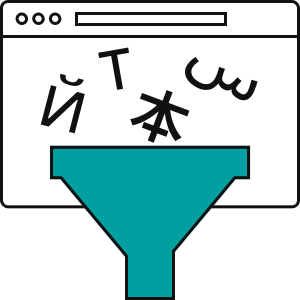
NetOwl supports entity extraction in multiple languages, including:
- English
- Arabic
- Chinese (traditional and simplified)
- French
- German
- Korean
- Persian (Farsi and Dari)
- Russian
- Spanish
The same comprehensive entity ontology available in English is also available for all the other languages, making multilingual and cross-lingual text analytics applications easier to develop.
Coreference Resolution for Advanced Entity Extraction
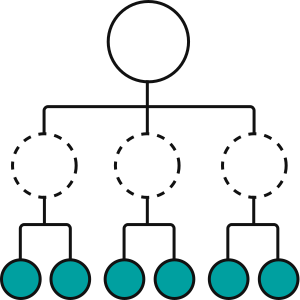
Entity Extraction is not only about identifying Named Entities, that is, names of people, organizations, places, etc., but also about identifying what names are mentions of the same entity. In fact, named entities often appear in various forms, from full names (e.g., Katherine Isabel Jones) to partial names such as last name only (e.g., Jones), first name only (e.g., Katherine), no middle name (e.g., Katherine Jones), and acronyms (e.g., FBI for Federal Bureau of Investigations, NYC for New York City).
Entity Extraction recognizes what names refer to the same entity via a complex process called Coreference Resolution. In addition to recognizing possible name variants, Coreference Resolution takes into account other factors such as:
- Gender. For instance, a last name like “Jones” in the context “Mr. Jones” will be assigned gender male and will not be a possible reference to “Katherine Jones”.
- Distance. The further away a name is from the closest previous mention (i.e., the so-called antecedent), the less likely it is that they refer to the same entity.
Coreference Resolution is required for more complete and accurate Entity Extraction. It is also important in order to calculate entity frequencies, which determine saliency and document topics, and in order to capture an entity’s correct and complete relationship and event information from content scattered throughout a document (e.g., “General Dynamics… GD purchased Praxis in 2018”)

Name Normalization
NetOwl not only performs entity extraction but also assigns normalized forms to extracted person, organization, and place names, taking into account capitalization, acronyms, abbreviations, nicknames, etc. When Smart Geotagging is used, place names are both disambiguated and normalized. Name normalization is ideal for cross-document name resolution for applications such as faceted search, and various forms of intelligence analysis such as geospatial analysis and link analysis.
NetOwl integrates easily with many popular search, geospatial, and business intelligence tools such as Elasticsearch and Esri ArcGIS.
Smart Name Translation
NetOwl Extractor’s Smart Name Translation provides English translation of named entities extracted from foreign language texts that use different alphabets/scripts, for example, Arabic, Chinese (traditional and simplified), Korean, Persian (Farsi and Dari), and Russian. Smart Name Translation gives an effective way for monolingual users to search and gist foreign language content.
Deploy on Premise or in the Cloud
Entity Extraction Solutions

Intelligence Analysis

Enterprise Search

E-discovery

Remove tag on Small
AML, KYC, PEP
Trusted by leading global organizations






Featured Blog Posts

What is Entity Extraction?
Entity extraction automatically identifies and classifies entities (e.g., people, organizations, places, products) in unstructured text using AI techniques.

How to Choose an Entity Extraction Product
In this blog, we describe 9 key factors to consider when choosing the best entity extraction product.

Entity Extraction for Knowledge Discovery
Organizations of all types need to discover critical knowledge contained in overwhelming, ever larger data volumes. That’s where Entity Extraction…
Discover what NetOwl can do for you!

Schedule a demo
Request a no-cost evaluation
Request our whitepaper